Aging report: which customers owe you money
Your receivables aren't a list — they're a clock. The buckets tell you exactly where your money is stuck and who needs a phone call.
Your receivables aren't a list — they're a clock. An aging report sorts every unpaid invoice by how late it is, and the buckets tell you exactly where your money is stuck and who needs a phone call.
The question "who owes me?" is hiding a worse one
Every business owner can answer "who owes me money?" — roughly, from memory, with rising blood pressure. The question the memory can't answer: who is about to become a problem?
The client whose invoice is 12 days late is normal. Net-30 means net-42 in the real world; everyone knows. The client at 55 days is a pattern forming. The client at 75 days with a second invoice now 20 days late is no longer a payment schedule — it's a credit decision you've been making accidentally, month after month, for a customer who may not be able to pay.
An aging report makes the difference visible before it becomes a write-off.
How an aging report works

One line per unpaid invoice, dropped into buckets by days past due:
| Bucket | What it means | What you do |
| --- | --- | --- |
|---|---|---|
| Current | Not due yet | Nothing. This is normal business. |
| 1–30 over | Late but ordinary | Friendly reminder, with the invoice attached |
| 31–60 over | Pattern forming | Direct conversation: "when can I expect this?" — get a date |
| 61–90 over | Credit risk | New work stops or goes prepaid; payment plan discussed |
| 90+ over | Collection territory | Escalate formally; decide if the relationship is worth more than the money |
The totals per bucket matter more than any single line. A business with 60% of receivables sitting in "current" is financing its customers politely. A business with a growing 60+ column is lending money it doesn't have, to customers it didn't vet, at 0% interest.
The number most owners have never computed: DSO
Days Sales Outstanding — the average days between invoicing and payment across everything. Rough version: (total receivables ÷ revenue for the period) × days in period. Track it quarterly.
DSO tells you how much of your money lives in other people's bank accounts as a standing condition of doing business. When DSO creeps from 38 to 47, the impact is exactly as dramatic as it sounds: on $50k of monthly revenue, those 9 extra days are ~$15,000 of cash permanently missing from your account. Nobody approved that loan. The aging report is where the creep becomes visible while it's still a conversation instead of a crisis.
The 20-minute weekly routine

1. Monday, open the aging view. Not the full invoice list — the buckets. Buckets force prioritization; lists invite staring.
2. Top of 31–60 bucket: one direct conversation. Not an email — a call. "I want to make sure everything's okay with the invoice" is friendly, and the answer is almost always informative (approval stuck, invoice lost, cash trouble, or plain slow — each implies a different next move).
3. Anyone entering 60+: decide, on purpose. Prepayment, pause work, or a payment plan with dates. The decision is yours either way; the report just makes you make it consciously.
4. Log the promise date. "Check's in Friday's run" goes next to the invoice. Friday, the report either confirms it or hands you the follow-up.
Prevention beats collection
The aging report is the cure; these are the vaccine:
- Invoice same-day on completion (your one controllable lag)
- Terms and due date printed large — "net 30" buried in footer small print isn't terms, it's decoration
- Deposits on anything custom — the clients who fight deposits are pre-identifying themselves for your 60+ bucket
- Credit pause rule in writing: one invoice past 60 = new work prepaid. Decided once, applied always, never personal.
The prebuilt version
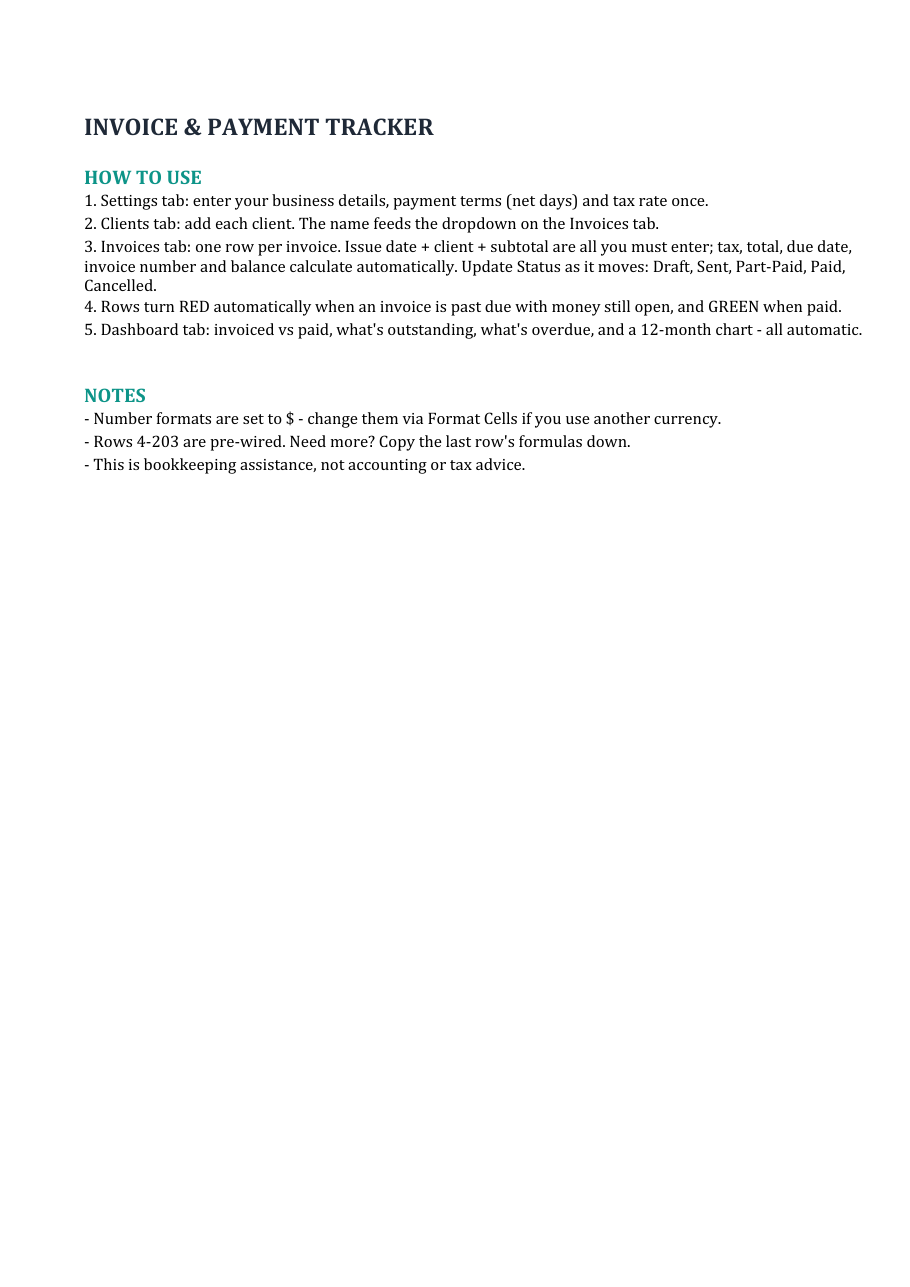
The Small Business Invoice & Payment Tracker (instant download) includes the aging view as a first-class screen — automatic buckets, DSO at a glance, overdue flags on the register, printable invoices — so the Monday routine is a glance, not a project. The Small Business Command Center adds cashflow: your receivables feed the 12-month forecast, so late payers show up as the tight months they cause.
Tracking tool, not legal or collections advice — collection rules vary by jurisdiction. Works in Excel and Google Sheets.
Invoices, expenses, clients, quotes and a 12-month cashflow forecast — linked in one workbook. Or start with the free forecaster.
Browse the templates Free forecaster